

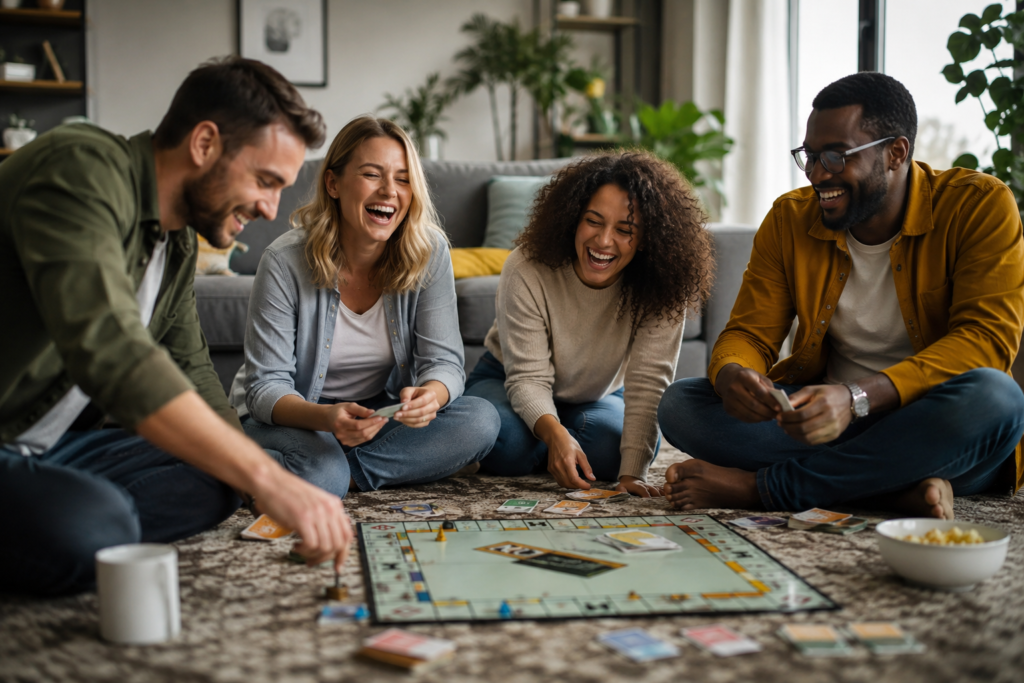
A conscious look at how we traded joy for productivity.
Somewhere between childhood and adulthood, many of us quietly stop playing.
Not suddenly. Not intentionally.
We don’t wake up one morning and decide that joy is no longer practical. It happens slowly and is too often replaced by deadlines, responsibilities, self-consciousness and the strange belief that everything we do must be useful and reap results.
Children play because they are alive to the moment. Their first language is play and rightfully so.
Adults often live as if every moment must justify itself.
And that may be why so many adults feel exhausted even when they are “successful.”
Play is not childish – it is consciousness in motion
Watch a child build a fort out of cushions and blankets or invent rules to a game that makes no logical sense. There is no outcome attached. No audience.
Just presence.
Play is one of the purest expressions of consciousness because it exists outside the economy of achievement. You do it for the experience itself.
Adults, however, are trained out of this state.
We learn that:
- Time must be productive
- Rest must be earned
- Hobbies should become side hustles
- Creativity should lead somewhere
- Fun without purpose is wasteful
Eventually, even leisure becomes performance.
We track workouts. Monetise art. Turn travel into content. Turn cooking into aesthetics. Turn reading into self-improvement. The modern adult often struggles to do anything that cannot be explained, measured, or displayed.
The fear beneath adulthood
Many adults do not stop playing because they dislike it. They stop because play requires vulnerability.
To play is to:
- look silly
- fail publicly
- improvise
- let go of control
- suspend identity
And adults become deeply attached to identity.
The professional.
The competent one.
The serious one.
The parent.
The achiever.
Play threatens these carefully managed selves because it asks us to enter uncertainty without guarantees.
That is uncomfortable for an ego built on control.
Adults still play, but only in approved forms
Interestingly, adults haven’t truly stopped playing.
They have simply renamed it.
We call it:
- networking
- fitness culture
- gaming
- wine tasting
- team building
- content creation
- personal development
Some of these are genuinely playful.
But often the spontaneity has been replaced by optimisation.
Even relaxation becomes another task to complete correctly.
The conscious question is not:
“Do I have hobbies?”
It is:
“Do I still know how to be joyfully useless?”
Conscious play reconnects us to ourselves
Real play dissolves psychological time.
You stop rehearsing the future.
You stop narrating your life.
You stop managing perception.
You simply participate.
This is why play feels healing. It temporarily silences the internal manager many adults carry around constantly.
Conscious play is not regression.
It is restoration.
It reminds us:
- curiosity matters
- imagination matters
- embodiment matters
- laughter matters
- meaning is not always productive
A healthy society would not ask adults to abandon play.
It would understand play as essential to mental, emotional, and spiritual wellbeing.
Maybe maturity was never meant to mean seriousness
Perhaps true adulthood is not becoming less playful.
Perhaps it is becoming responsible without losing aliveness.
The wisest adults are often the ones who can still:
- dance without embarrassment
- explore without agenda
- laugh loudly
- wonder openly
- be present without needing to win
Play is not the opposite of maturity. Maybe the real tragedy is not that adults grow old –
but that so many grow emotionally unavailable to joy long before they have to. The saddest time truly only comes when the child in your life no longer asks you to play. Not because they don’t want to but because you don’t know how.
Leave a Reply